
Scoping Formula Exclusivity: Questions to Settle Before You Sign
Formula exclusivity is not one clause but a bundle of separate decisions: which formula is protected, against whom, in which channels and territories, for how long, and what happens when the relationship ends. Brands that negotiate a single exclusivity sentence usually find the gaps later, when a similar scent appears in a channel nobody named. The practical answer is to treat exclusivity as a scoping exercise and settle each element in writing before the first purchase order.
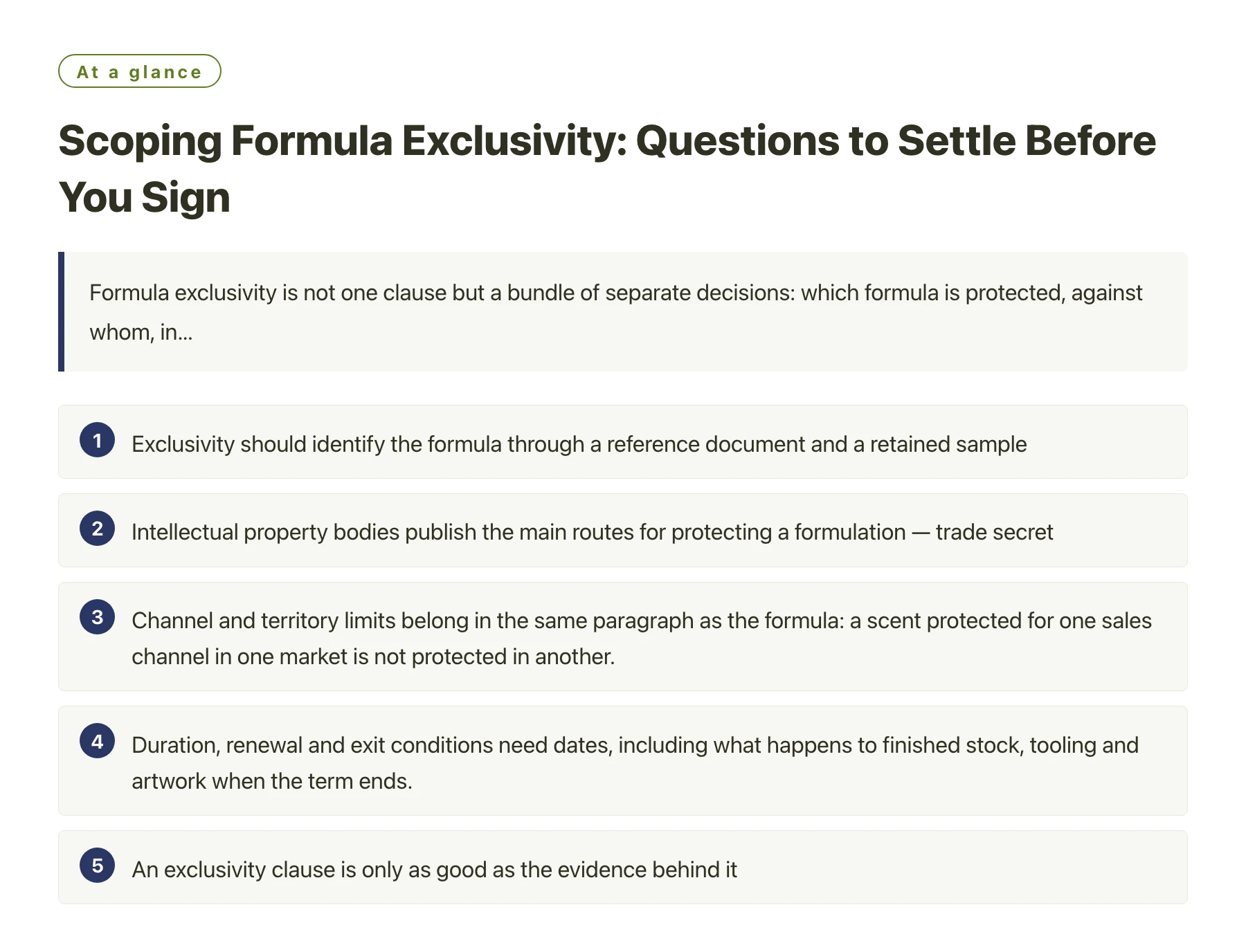
Key takeaways
- Exclusivity should identify the formula through a reference document and a retained sample, not through a product name, because product names survive reformulation and formula documents do not.
- Intellectual property bodies publish the main routes for protecting a formulation — trade secret, patent or registered design — and each route carries different disclosure duties that affect what you can keep confidential [1].
- Channel and territory limits belong in the same paragraph as the formula: a scent protected for one sales channel in one market is not protected in another.
- Duration, renewal and exit conditions need dates, including what happens to finished stock, tooling and artwork when the term ends.
- An exclusivity clause is only as good as the evidence behind it, so agree who holds the sealed reference, the specification and the batch records, and for how long.
- Because every regulated market lists and restricts ingredients differently, an exclusivity claim has to survive reformulation pressure as well as commercial pressure [2].
Most exclusivity discussions begin with the wrong question. The brand asks whether it can have the scent to itself, the manufacturer answers yes, and both sides leave the meeting believing they agreed on the same thing. What they actually agreed on was a word, and the word hides at least six decisions.
This article walks through those decisions in the order they become enforceable: identification, scope, channel, territory, duration and evidence. It is written for brands selling through their own online store, where a scent is often the single largest differentiator and the hardest asset to replace.
Nothing here requires a manufacturer to be difficult. A partner such as Xuelei Cosmetics will normally confirm in writing which parts of a formula it treats as customer-specific and which parts it holds as its own background know-how, and that confirmation is where a usable scope conversation starts.
Identify the asset before you protect it
A formula is a document, not a smell. If the contract protects "the fragrance known by a product name", then the protection is attached to a name, and a reformulation, a rename or a move to a second product can quietly leave the asset unprotected. The clause should instead reference a dated formula version, a specification revision number and a sealed sample held by both parties.
The same logic applies to the brief. If the brand wrote a detailed creative direction — a reference set, a note structure, a target market — that brief is arguably the origin of the asset, and it is worth listing as an attachment. Where a project mixes a manufacturer's existing library accord with new work, the contract should say which layer is customer-specific and which remains the manufacturer's background.
This is also where a brand needs to be honest about its own contribution. A brief that arrives as three words and a moodboard is unlikely to support a claim over the resulting scent, whereas a documented development process with the brand's own choices recorded at each gate is far easier to defend.
Formula, variant or brief?
Ask the manufacturer to describe, in one paragraph, what would count as a breach. If the answer covers only an identical compound, the clause is narrow. If it covers variants within a stated similarity band, it is wider and usually more useful, though it can also be harder to test. The point is not to demand one answer but to know which one you have.
The scope elements and the question each one has to answer
| Scope element | Question that must be answered | A weak version | A version you can enforce |
|---|---|---|---|
| Identification | What exactly is protected? | The product name | Formula version, specification revision and sealed reference |
| Depth of protection | Does it cover variants? | Identical compound only | A stated similarity band with a named comparison method |
| Counterparties | Who is bound by it? | The manufacturing entity only | The entity, its affiliates and any subcontractor named in the order |
| Channel | Where may the scent be sold? | Left silent | Named channels, with retail marketplaces treated explicitly |
| Territory | Which markets are covered? | Left silent or "global" | A named list plus a process for adding markets |
| Duration and exit | When does protection start and end? | One sentence, no dates | Start at purchase order, end at a defined date, with stock and tooling handled |
The fourth column is the one worth arguing about. It usually costs nothing to obtain because it asks the manufacturer to be specific rather than to give something away.
Three places exclusivity commonly leaks
The first leak is the variant problem. A factory that cannot sell the identical compound can still sell a scent that reads the same to most consumers, built from the same accords with one material replaced. Whether that is a breach depends entirely on how the similarity band was written, which is why vague language favours the party with the better lawyer rather than the party that paid for development.
The second leak is subcontracting. Where filling, decoration or secondary packing sits with third parties, those parties receive the formula, the specification or both. The contract should either bind subcontractors or require notification before any transfer, and it should say what the brand is told when that happens.
The third leak is market-driven reformulation. Restriction changes, material discontinuities and local listing requirements can force a formula to change after launch, and each change raises the question of whether the exclusivity follows the new version. The European Commission's market-facing material on cosmetics is a useful reminder that the same product can carry different obligations in different markets [3], and the contract should say that exclusivity travels with the reformulated version while the customer account is active.
Make the development split explicit
Where the brand pays for development, the scope conversation is different from a project built on a library accord. A partner that offers custom fragrance R&D and production should be able to state which of its development stages are charged to the project and which are treated as background investment, because that split often decides who owns what.
The evidence pack that makes the clause real
Enforceability is a documentary question. At minimum, the brand should leave the project holding a signed formula specification, an approved and sealed reference sample, a batch record or certificate for the bulk order, the artwork files that carry the brand's identity, and a written statement of the exclusivity terms including dates. In practice, the sealed sample does more work than the wording, because it is the only artefact that can settle a disagreement by being smelled.
A company account of its own scope is a reasonable starting point for the conversation but never a substitute for the contract. Reading about Xuelei is a way to understand how a manufacturer describes its history and certifications; the exercise that matters is converting each relevant sentence into an obligation with an owner and a document.
It is also worth agreeing a review date. Formula exclusivity that was right at launch can be wrong two years later, after a range extension or a new sales channel. A short annual check keeps the scope aligned with the business instead of with the memory of a meeting.
If a manufacturer refuses to name a reference sample, a formula revision or an exclusivity end date in writing, treat that refusal as a data point rather than a deal-breaker. It tells you that the enforceable part of the relationship will rest on goodwill. Ask for a one-page scope summary covering the six elements above, and compare what comes back against your own list before you sign anything.
Sources
- WIPO — World Intellectual Property Organization —— The UN agency for intellectual property; resources on industrial design and patent protection relevant to product and packaging design.
- EU CosIng — Cosmetic Ingredient Database (European Commission) —— The European Commission's CosIng database of cosmetic ingredients, listing ingredient functions, restrictions and labelling requirements under EU cosmetics law.
- European Commission: Cosmetics in the EU —— The European Commission's overview of EU cosmetics rules, including the responsible person, product information file and safety report requirements.
Frequently asked questions
Does paying for development automatically give the brand ownership of the formula?
Not automatically. Payment for development work and ownership of the resulting intellectual property are separate questions, and many standard terms separate them. The contract needs to say who owns the formula, what the manufacturer retains as background know-how, and how the brand can take the formula elsewhere.
Should exclusivity cover variants of the scent or only the exact formula?
Variants are where most of the commercial value sits, because a nearly identical scent can compete with yours. A similarity band with a named comparison method is more useful than an exact-match clause, even though it is harder to write and requires both sides to agree how a dispute would be tested.
How long should formula exclusivity last?
Long enough to cover the product life cycle you have actually planned, plus a transition period. A term tied to the active supply relationship with a notice period is often more practical than a fixed number of years, because it keeps protection and supply aligned.
What happens to exclusivity if a raw material is discontinued?
Decide in advance. The clause should say that the manufacturer will propose the closest compliant substitution, that the brand approves it, and that exclusivity continues on the reformulated version. Without that sentence, a forced reformulation can be argued to sit outside the original scope.
Can a small online brand ask for exclusivity at low volumes?
Yes, but the scope usually has to be narrower to be realistic. Territory and channel limits, a defined term and a volume commitment are the levers that make a narrow exclusivity request acceptable. Asking for global, perpetual, all-channel protection on a first small order is rarely agreed.
Ship something measurable by next Tuesday.
Book a 30-minute scoping call. We'll send a senior lead, a one-page scope, and a fixed-week price before the call ends.
Book a Sprint Call →